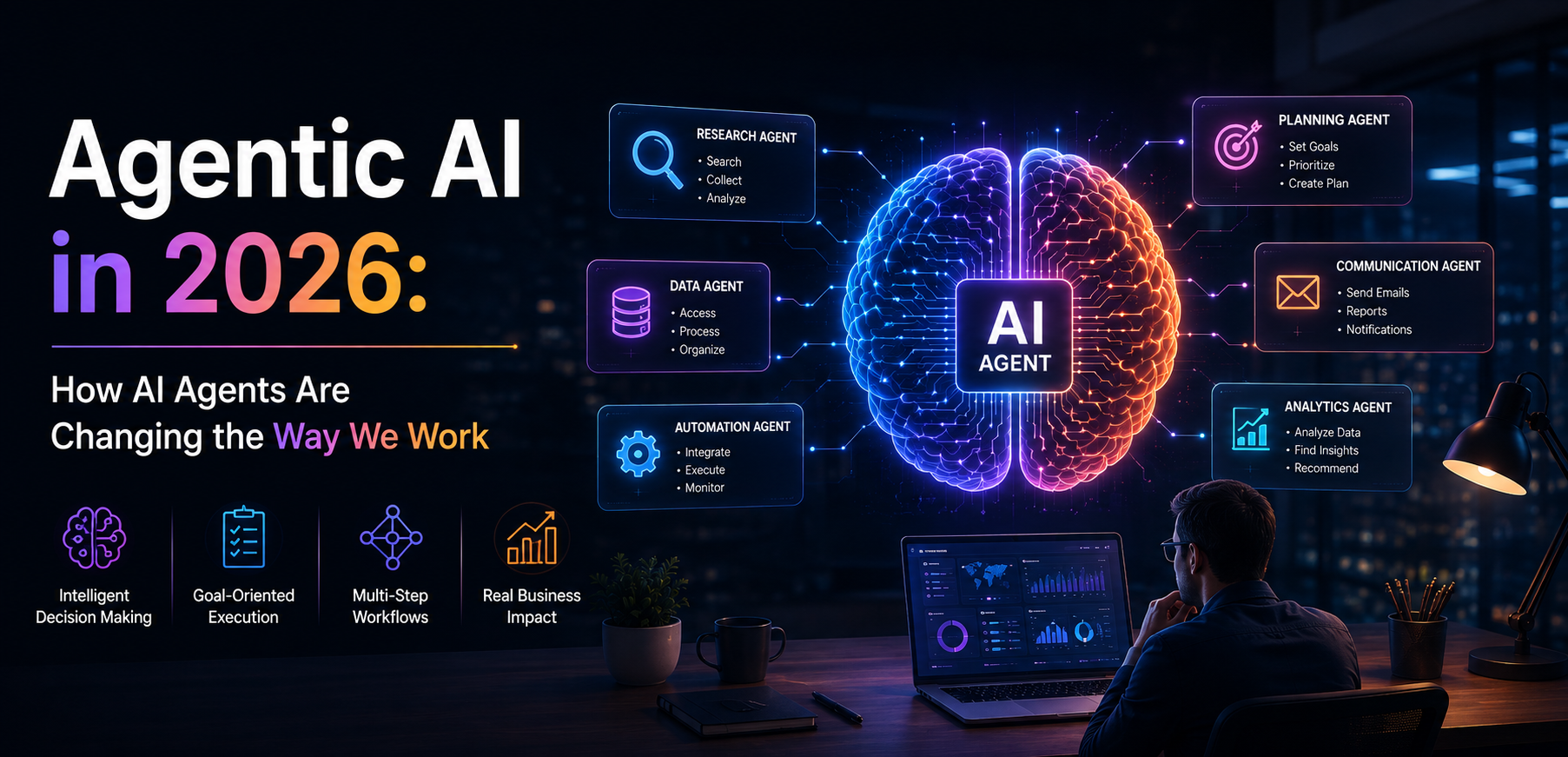
Artificial intelligence is evolving faster than it has ever. In just a couple of years, AI has moved from simple recommendation and chatbots to robust dynamic AI instruments that can create video, text, images codes, and much more.
The next big change is in progress.
AI moves beyond responding to questions, but also acting.
This innovative approach is referred to by the name of Agentic AI.
Contrary to conventional AI devices that generally require a user to present instructions on each stage, AI agents can be developed to be able to recognize a need and plan several steps. employ digital tools to analyze the data, and finish tasks using the assistance of a human.
The year 2026 is the one to watch. Agentic AI has become one of the most talked about AI areas because enterprises are focusing on the ways AI could be integrated into the daily workflow of their employees instead of being a chatbot, or tool to generate content.
What does it mean to be Agentic AI, how does it operate and what will be the implications for the future of the workplace?
Let's explore.
What Is Agentic AI?
Agentic AI is a term that refers to artificial intelligence (AI) systems created to achieve an objective and follow many steps in order to accomplish it.
A typical AI interaction could look something like this:
HTML1 A user asks questions -- AI gives an answer Conversation is over.
A system of AI that is agentic may perform differently
Goals - Plan - Data gathering and tool usage - Assessment and completion
As an example, suppose the business is trying to attract new customers.
A typical AI chatbot could explain ways to locate leads, or create the list of search terms.
A AI agent, if coupled to the correct devices and with the proper authorizations, can potentially conduct research on businesses, gather relevant data and identify potential customers, sort the data, and organize it for examination.
What is significant is the fact the fact that Agentic AI isn't focused just on providing an answer, but also on the completion of a task or a workflow.
This is the reason AI agents are being increasingly classified as smart assistants, digital or even intelligent.
Why Is Agentic AI Trending in 2026?
Generative AI has dominated discussions about artificial intelligence in the past couple of years.
Users became acquainted with software capable of writing emails, make images, documents that are summarized make code and respond to questions.
However, businesses quickly realized that producing content was just one element of the problem.
Automation was the biggest opportunity.
Businesses sought AI which could aid with whole processes, not just specific tasks.
As an example, rather than having to ask AI to create one email, organizations need systems that could:
Locate the ideal client
Study their company
Learn to recognize their needs
Create a personal message
Update the CRM
Follow-ups are scheduled for the following day.
Study the response
This transition from creation of content to the execution of tasks is among the primary motives Agentic AI is receiving so many acclaim.
Google Cloud has identified agentic AI as a key field of research, with a particular focus in systems that can handle complicated, complete workflows. The major technology companies are creating infrastructure to deploy controlling, monitoring, and managing AI agents within real-world workplaces.
It is thus heading towards a fresh question:
What is AI be able to do for us?
How Do AI Agents Work?
AI-powered agents are built with different methods, but many agentic systems incorporate several essential features.
1. Understanding the Goal
The first step is that the AI must be able to comprehend what the user is trying to achieve.
Examples:
"Analyze our customer feedback and find the biggest problems."
The agent identifies its goal and decides on the data it requires.
2. Planning the Task
Instead of directly generating an answer in a hurry, the agent could break the task into smaller pieces.
It could decide:
Collect customer feedback
Sort the complaints into categories.
Find the recurring issues
Examine the frequency
Look for potential causes
Create suggestions
This capability to dissect the complex goals is among the most important characteristics of agents. systems.
3. Accessing Information
AI agents could require access to various sources of data.
Depending on the way they are configured They could comprise:
Databases for companies
CRM systems
Documents
Websites
Knowledge base
Spreadsheets
Business-related applications
The agent can use information that is not part of the context of the conversation.
4. Using Tools
Tools are a crucial component in Agentic AI.
A AI agent could be linked to databases, APIs or APIs as well as email platforms, search engines and coding environments, as well as different software.
It means that the agent will be able to interact with digital technology instead of just explaining what the user needs to do.
5. Taking Action
After gathering the information and deciding what action is required an agent will be able to carry out the action he has been authorized to do.
It could, for instance, produce a report, modify an existing CRM record, write an email, categorize documents, or even trigger a procedure.
But, any sensitive action must still require control of security and approval by a person.
6. Evaluating the Result
Advanced agents are also able to evaluate the extent to which their work is achieving the goal they set out to achieve.
If there is a problem The system could move on to another stage.
It creates a continual cycle:
Plan - Act - Observe - Evaluate - Continue
This is the reason why agents different from questions-and-answer AI.
Agentic AI vs Generative AI
The two fields of AI, generative AI and agentic AI are both closely related however they're distinct from each other.
Generative AI is focused primarily in creating the content.
It may result in:
Text
Images
Videos
Audio
Code
Summaries
Agentic AI, in contrast is focused on reaching goals by taking multiple actions.
The easiest way to grasp the distinction is to:
Generative AI"Write an email marketing to me."
Artificial Intelligence: "Find suitable prospects, research them, prepare personalized emails and organize them for my approval."
A AI agent could actually employ the model that is generative AI model for one or more of its parts. It is different because it adds planning devices, memory, tools and workflow features to the model.
How Are Businesses Using Agentic AI?
The possibilities of applications for AI agents are growing rapidly.
Customer Service
Customer support is among the more obvious usage cases.
A AI agent may be able to understand the customer's needs, locate pertinent information, determine the most appropriate answer and in completing the support process.
This will reduce the need for repetitive tasks as well as allow employees to concentrate on more complex customer issues.
Sales and Lead Generation
Sales staff spend lots of their time investigating organizations, looking for decision makers and coordinating CRM data.
AI agents could help by performing these repetitive tasks.
Example:
Company Research - Prospect Identification - Lead Qualification - Personalization - CRM Update - Human Review
It could also allow sales people to concentrate on establishing relationships rather than manually gathering data.
Marketing
Marketing teams are able to utilize AI agents to assist with the research process, analysis of campaigns as well as content and report planning.
A person could track campaign information, spot crucial changes and write a summary of the information marketers require.
Instead of navigating through several dashboards at once Employees could get an organized overview of crucial data.
Software Development
AI agents are increasing useful for programmers.
A coder can analyse a project, comprehend specifications, code it as well as run tests to identify any potential mistakes.
However, this does not mean the need for developers is gone.
Instead, developers are able to focus more on the architecture products, product choices and complicated problems, as AI aids in routine development tasks.
Research and Data Analysis
Analysts and researchers often have to obtain information from many sources.
AI agents could help by collecting information by organizing information, making it easier to compare results and writing reports.
This will significantly decrease the amount of time needed for repeated study.
What Are Multi-Agent Systems?
A further interesting advancement could be the multi-agent AI.
Instead of requesting one AI agent to handle each task, companies could create multiple agents with specialized skills.
Examples:
Search Agent Searches for details.
Analyser Agent analyzes the details.
Write Agent is the agent that creates the report.
Review Agent • Checks the results.
Manager Agent coordinates the whole process.
The agents may work in a virtual team.
This strategy is particularly helpful in complex workflows, that require a variety of tasks with distinct abilities.
As AI agents develop ecosystems for themselves and evolve, the communication among different agents as well as interoperability between platforms are increasingly becoming crucial areas for study and research.
Benefits of Agentic AI
One of the biggest benefits to Agentic AI is the ability to automatize tasks that needed manual effort.
Increased Productivity
AI agents are able to handle routine tasks, which allows employees to concentrate on more valuable tasks.
Faster Workflows
Agents are able to process data and accomplish certain tasks more quickly than traditional manual processes.
Better Scalability
The business can use several agents in different departments, and processes.
24/7 Availability
Digital agents are able to operate 24/7 with no limitations on working hours.
Reduced Repetitive Work
Workers can be less focused working on tedious analysis, data entry and other routine tasks.
Better Decision Support
AI agents are able to collect and organise information in order to assist users make better informed choices.
These benefits, however, depend on the reliability of the AI system, its data as well as the tools used and supervision by humans.
What Are the Risks of Agentic AI?
A greater degree of autonomy comes with greater accountability.
If chatbots give an incorrect response it could be limited to inaccurate information.
If an AI agent is permitted to make decisions in error, the wrong decision can possibly affect business financial records, or security.
There are a number of important issues.
Security
AI agents could be able to access sensitive information and systems. The permissions they have to access must be monitored carefully.
Privacy
Companies must ensure that confidential and personal data is appropriately handled.
Incorrect Decisions
AI may still be prone to errors. AI should not be able to always be trusted to make all important decisions.
Lack of Human Oversight
Certain tasks require a human's judgment especially when it involves financial matters, legal concerns customer information, or customers.
Accountability
It is important for companies to understand the person accountable in the event that an AI agent is unable to correct an error.
This is why accountable Agentic AI requires a strict control, monitoring, and testing, as well as permissions and a system of governance.
Will AI Agents Replace Human Jobs?
It is among the most important questions regarding Agentic AI.
There is no simple yes or no.
AI systems are expected to be able to automate certain routine jobs. Tasks that involve regular analysis, data processing, routine analysis, and standard workflows might change drastically.
Automation does not have to ensure that every profession is eliminated.
The responsibilities of the job may shift.
Marketers may not spend as much time creating reports and spending greater time preparing strategies.
An experienced developer could be able to spend less time writing repetitive code and instead spend time creating software.
Salespeople may not spend as much time researching potential customers and spend spending more time with customers.
It could be that the future will not look like:
Humans vs AI
However, it is more likely:
Humans + AI
Human abilities such as communication, creativity the ability to lead, the ability to think critically and make judgments will remain important.
What Does the Future of Agentic AI Look Like?
Agentic AI is in the process of developing however, several patterns are starting to become apparent.
AI systems are expected to be better at analyzing difficult tasks using various methods and keeping relevant information.
The focus of businesses will be on connecting agents with current software systems.
In the meantime security and government will be more and more crucial.
Most successful businesses are not always those that have the strongest AI models.
These could be the businesses who understand:
What are the tasks that should be automated?
What data should AI access?
Which activities require the approval of
What AI performance can be evaluated?
Humans must be in the process
Future developments in AI could therefore become less about replacing humans but more focused on increasing human capabilities.
Frequently Asked Questions
What is Agentic AI?
Agentic AI is a method to artificial intelligence, where AI systems are able to pursue their goals through planning and executing tasks employing tools, and then taking action instead of answering to specific prompts.
What exactly is what is an AI agent?
A AI agent is a computer that is designed to comprehend the goal, execute various steps, and utilize various tools that can be used to finish the task with defined permissions.
What's the distinction what is the difference between Agentic AI and Generative AI?
Generative AI is primarily used to create content, like text, images or codes. Agentic AI is focused on meeting objectives through the planning of tools, utilization and the steps.
What are the best ways to use AI agents?
Enterprises can utilize AI agents to assist customers with customer service and sales as well as marketing research, development of software as well as data analysis and the automation of workflows.
Are AI agents secure?
AI agents are safe provided they're properly designed checked, monitored, and have the right permissions. The sensitive actions must be accompanied by human supervision.
Are there plans to let AI agents be able to replace human beings?
AI robots will probably automate some tasks, and will change a lot of tasks, however humans will remain an a crucial role in the process of strategy and creativity, as well as communication judgement and decision-making.
Conclusion
Agentic AI marks a crucial step forward in the development in artificial intelligence.
Generative AI has shown us that computers can produce content.
Agentic AI is advancing to the next step in giving AI systems to achieve objectives, employ instruments and be part of real-world workflows.
From sales and customer service to software development, marketing as well as research AI agents may change the way companies work.
The real benefit of Agentic AI won't come in the form of machines having unlimited autonomy.
This will be determined by realizing the ideal equilibrium between the capabilities of AI and the human element.
As AI agents get more proficient as they advance, businesses and individuals who learn to collaborate efficiently with them could benefit from a substantial edge.
Artificial intelligence's future will not be just about intelligent chatbots.
It's about AI which can be able to comprehend, plan, and act with us.
and Agentic AI could be one of the technological innovations that define the future of technology.