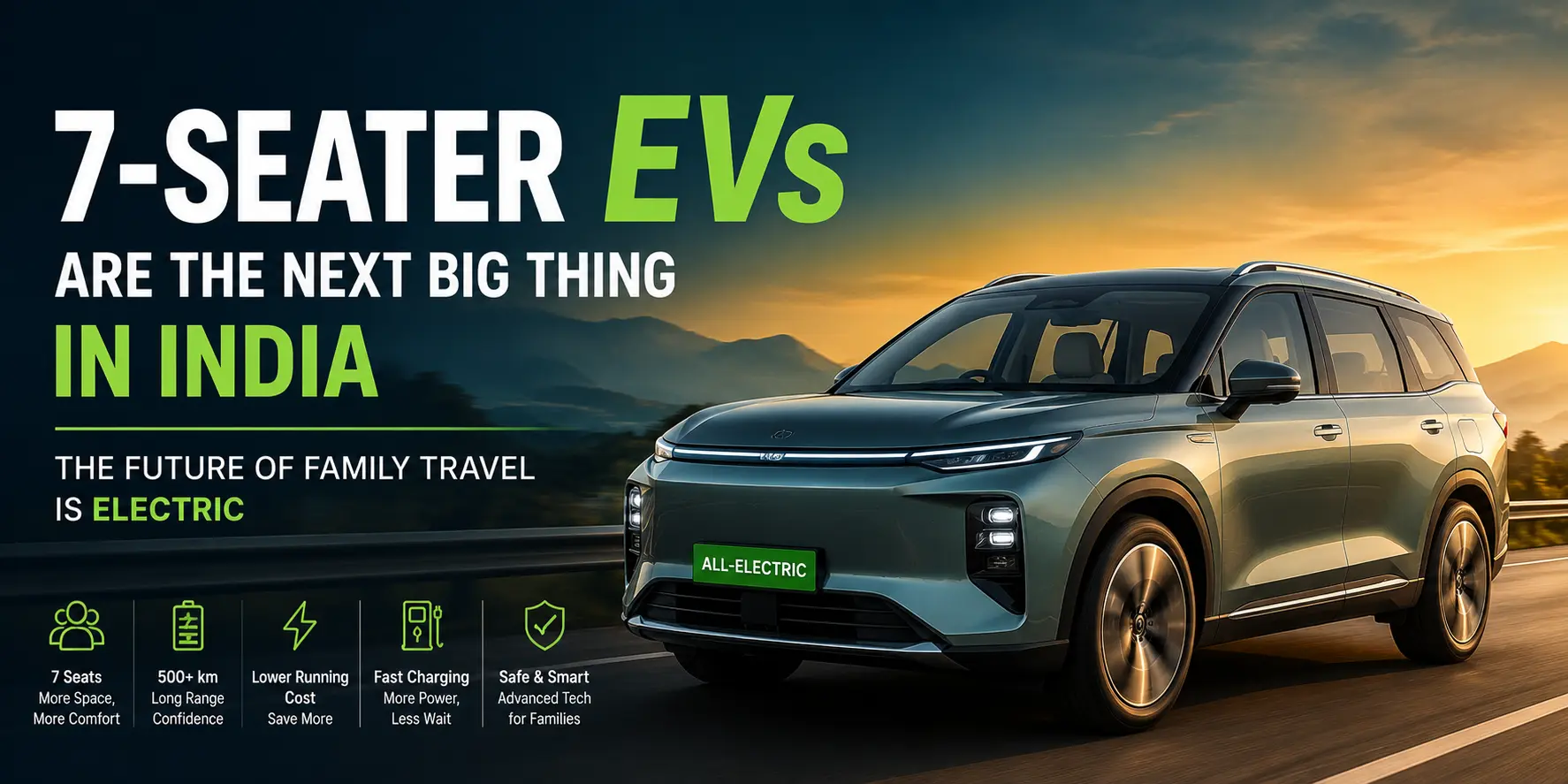
7-Seater EVs Are Becoming the Next Big Thing in India
India's auto market is experiencing one of its most dramatic changes over the past few years.
In the past, Indian car buyers mainly could choose from three options for a family car. CNG, diesel, or petrol. Electric vehicles are now becoming an increasingly viable fourth choice and the next significant battlefield could be the seven-seater electronic SUV.
The reason for this is quite simple.
Indian families are looking for larger cars with more space, improved technology, and lower operating expenses. While at the same time the electric vehicle technology is rapidly evolving as manufacturers work to improve the size of their batteries, their running ranges, and more rapid charging.
Markets are now shifting past small electric hatchbacks as well as small city vehicles.
The next step could belong to big electric SUVs that are made for families.
This is expected to become fascinating in 2026 when a variety of makers are working on innovative electric SUVs to target in the Indian market. One of the most recent models is MG's forthcoming seven-seat electric SUV set to go on sale on the 26th of August 2026. The firm declaring a range of greater than 500 kilometers.
However, why is the 7-seater EVs quickly becoming an integral part of the auto story in India?
Why Indian Buyers Want 7-Seater Cars
The Indian auto market has always been in huge demand for family-friendly automobiles.
A car with five seats might be adequate for a smaller family however larger families typically require more seats for children, parents family members, friends or relatives.
That's one reason MPVs and SUVs have become more popular.
The 7-seater car offers flexibility.
It can be used to be a regular family vehicle for the week, and also carry more passengers if needed.
The increase in SUVs has altered expectations for consumers. Customers are increasingly looking for better seating, more spacious cabins, more road-side visibility and a host of other features.
Electric vehicles are in this sector.
This could lead to a significant combination of:
SUV-like practicality with seven seats and electrical power.
The EV Market Is Moving Beyond Small Cars
As electric vehicles first began being widespread in India in the early 2000s, the market was predominantly focused on smaller vehicles.
Less powerful EVs are a sensible choice for many reasons.
They needed smaller batteries. they were more convenient to charge, and were mostly used for urban commutes.
The expectations of consumers are evolving.
Many people are increasingly looking for EVs capable of doing more than the daily commute.
They would like to move between cities, go on family road trips, and utilize the same vehicle to serve multiple functions.
It's a sign that range has been one of the most important factors when it comes to EV purchase decision-making.
An SUV powered by an electric motor with 500-plus km of claimed range could thus attract customers who had previously deemed EVs not practical for their needs.
The forthcoming MG 7-seater electric vehicle is a prime illustration of this trend and its 500+ miles of range making it a family-friendly electric vehicle with a long range.
Why 500+ Km Range Matters
It is one of the main concerns of those thinking about an electric vehicle.
The buyer might like this technology, but be concerned:
"What will happen if the battery is not charged during an excursion on the highway? "
This issue becomes more crucial for vehicles used by families.
If you buy a seven-seater vehicle is likely take it on long-distance trips as opposed to someone who purchases smaller city-sized EV.
The 500km-plus claims of range are becoming an important point of sale.
In theory, a long-range EV could make a Delhi-to-Jaipur-style road trip much easier without requiring frequent charging stops.
But, the real-world range will always be affected by various variables, such as:
The speed of the car
Air conditioning
Amount of passengers
Road road conditions
Weather
The driving style
Condition of the battery
The use of rapid charging
So, consumers shouldn't assume that the claimed range of the product does not always correspond to the actual highway distance.
However, the larger battery size as well as improved efficiency make longer-range electric vehicles more practical.
Charging Infrastructure Will Decide the Future
It is only one component of the EV calculation.
Infrastructure for charging could become more crucial.
Imagine purchasing a huge electric vehicle, but having to find a reliable, fast charger on the highway.
This could result in owners feel frustrated.
In order for EV use to increase to the next level, India needs more charging stations that are located in:
Highways
Cities
Neighborhoods for residential use
Shopping centres
Office complexes
Hotels
Airports
Parking Facilities
The charging experience needs to improve and become more reliable.
Customers don't want to waste long amounts of time waiting on their car to be charged on a long drive.
As the more longer-range EVs are introduced to the market, the charging infrastructure is expected to expand along with the new vehicles.
Why 7-Seater EVs Could Be Attractive to Families
A huge family EV might have many benefits.
Lower Running Costs
Electric motors are extremely efficient in comparison to conventional internal-combustion engines.
If you are a frequent driver their mileage, the cost per mile may be cheaper than those who drive diesel or petrol.
The savings actually depend on prices for electricity and charging locations, as well as vehicle performance and the driving habits.
The home charging option is considerably more convenient than going to an outlet for fuel.
Quiet Driving Experience
Electric motors emit considerably less engine noise as diesel and petrol engines.
This could make lengthy travels with your family easier.
A quiet interior can make a difference to the luxurious experience of an electric vehicle.
Instant Performance
Electric motors are able to deliver powerful torque in a matter of minutes.
It can also make big EVs appear to be surprisingly fast regardless of their dimensions.
A 7-seater SUV with immediate torque could be beneficial during highway crossings and climbing.
More Technology
Electric vehicles are becoming advertised as products of technology and not just vehicles for transportation.
The most recent EVs may comprise:
Large infotainment displays
Connected-car technology
Digital instrument clusters
Advanced driver aid
Smartphone connectivity
Updates to software that are available over the air
Multiple drive modes
Advanced technology for climate control
This tech-oriented experience is likely to be highly appealing to buyers who are younger.
The New Competition in India's EV Market
The electric vehicle market in India is getting more fiercely competitive.
Manufacturers aren't focusing exclusively on tiny EVs.
A number of companies are working on larger electric SUVs, as well as high-end electric cars.
Recent media coverage of the sector has highlighted numerous electric SUVs coming in the near future which include models made by Tata, MG, Maruti Suzuki, Hyundai and Mahindra. Certain models coming out are likely to be targeted at the family SUV market.
The competition may benefit consumers.
A greater number of manufacturers competing to compete to serve the same client typically means more choices.
The same can be used to push businesses to do better:
Technology for batteries
Driving the range
Speed of charging
Interior quality
Safety
Software
Pricing
Warranty
After-sales service
This could lead to an older EV market.
EVs Are No Longer Only About Saving Fuel
One of the major shifts in the way consumers think is that EVs have ceased to be exclusively purchased for the sake of the savings on fuel.
Technology is also becoming increasingly important.
The modern EV buyer may desire an electric vehicle that is like a futuristic.
They might be concerned about:
Design + Technology + Performance + Range + Comfort + Sustainability.
This is particularly relevant for the SUV category.
An electric vehicle of a large size can give the kind of road presence that people would expect from an expensive vehicle and offer a completely new driving experience.
Will 7-Seater EVs Be Affordable?
It is among the main issues.
Batteries are among the costliest components in the electric car.
A 7-seater SUV that is large needs a bigger battery than a electric vehicle for city use if the company intends to offer a long-range.
This increases the cost of manufacturing.
So, seven-seater EVs might initially fall within the premium or mid-range segment.
The battery technology, however, continues to advance as well as economies of scale can gradually lower prices.
When manufacturers manufacture larger quantities of EVs manufacturing costs be efficient.
That's one reason why the upcoming years may be crucial for the electric vehicle market in India.
Why SUVs Are Perfect for EV Technology
The technology of EVs and SUVs could even complement one another.
Large SUVs generally use more fuel due to their weight and size.
Electric powertrains are able to provide more efficient drivetrains.
The result is that electrification could lower one of the major drawbacks of larger vehicles, the high cost of running.
An electric vehicle of a large size can thus combine
Space + Comfort + Performance + Efficiency.
This combination can attract electric SUV people who have previously avoided EVs due to the need for more space for their family.
The Road Trip Question
The most significant test for an EV with seven seats will be on the highway.
The commute to work in urban areas is fairly easy with an electric vehicle.
The battery can be charged at home over night and then start your next day with a fully charged battery.
Traveling long distances can be more complex.
Drivers want secure charging stations that are reliable, with predictable charging times, and a sufficient amount of coverage.
It means that the performance of seven-seater EVs is contingent upon the network of charging on India's highways.
If charging infrastructure improvements are speedy Long-range EVs are likely to become more suitable for trips on the road.
If growth in infrastructure is slow and the economy remains stagnant, people may choose diesel, petrol or hybrid SUVs to travel long distances. journeys.
What About Battery Life?
Battery longevity is a different aspect to consider.
Prospective buyers frequently ask questions like:
"How much time will the battery last? "
The latest EV batteries are made to run for years However, battery performance may decrease gradually over time.
They generally offer warranties on the powertrain, battery and electrical components up to a certain time frame or miles.
The consumer should be aware of:
Warranty on batteries
Warranty on the vehicle
Charger warranty conditions
Policies on battery replacement
Service Network
Support for software
A lower EV does not mean it is the best deal when the support for ownership is low.
Are 7-Seater EVs Better Than Petrol or Diesel SUVs?
There's no single answer.
It is contingent on the way in which the vehicle will be utilized.
An EV might be more suitable in the case of someone:
The driver is often in the city.
Does the home have access to charging
Are you looking to lower the running cost of your business?
Loves technology
Does it have predictable regular daily patterns of driving
An SUV powered by diesel or petrol might be a good choice to someone who
Sometimes, she travels to remote areas
Access to charging is not always available.
Drives very long distances
Wants quick refuelling
lives in areas that has a limited infrastructure for charging
The ideal vehicle will depend on the person buying it.
The Rise of Electric Family Cars
The next stage in India's adoption of EVs could include the change from an individual ownership of EVs to family-owned EV ownership.
In the beginning, EV purchasers were typically tech-minded and commuters in urban areas.
The next wave may include normal families.
This is important because families of buyers are different in their priorities.
They're looking for:
Safety
Reliability
Space
Comfort
Long-range
Affordable ownership
Great service
Strong resale value
If electric vehicles can live up to the expectations of consumers, EV adoption could accelerate dramatically.
India's Automobile Market Is Already Showing Strong Growth
The wider Indian auto industry is witnessing a surge in sales.
Based on SIAM statistics released in August 2026, passenger car sales reached 4,57,810 units by the month of July in 2026 that's an 34.3 percentage increase over the previous year as well as the highest-ever sales in July for this segment.
This is a crucial context to this EV story.
Cars and other vehicles are being purchased by more consumers and companies are competing hard to win new customers.
The expanding market for cars provides an opportunity in the electric vehicle market to take an increased share.
More EV Choices Could Change Consumer Behaviour
In the past, buyers were often forced to compromise in order to purchase an electric vehicle.
Perhaps they were impressed by the technology, but not the options.
Perhaps they were impressed by the variety but didn't love the look.
Perhaps they were looking for an SUV but were unable to locate an electric vehicle with the appropriate price.
A greater number of models could reduce these risks.
When manufacturers introduce EVs in a variety of price ranges and styles of body, consumers will have a greater choice.
This can be a positive feedback loop
More Models - More Competition - Better Technology - Better Pricing - More Buyers.
What Could Stop the EV Boom?
Even with all the enthusiasm, EV adoption still faces obstacles.
High Initial Price
Electric vehicles can come with higher initial costs than similar petrol vehicles.
Charging Infrastructure
Access to charging remains crucial especially outside of major cities.
Battery Replacement Concerns
Consumers are still wary of cost of battery replacement over the long term.
Resale Value
The utilized EV market is in the process of developing.
Technology Changes
The rapid advancements in battery technology could create a fear among consumers that the current electric vehicle could be outdated in a short time.
The issues must be resolved in order for EVs to be accepted as a standard.
What the Future Could Look Like
Imagine the Indian family that buys a 7-seater electric vehicle five years in the future.
Then they charge it in their homes overnight.
The vehicle will automatically plan routes based on the charging stations.
When you travel on the highway it is the navigation system that determines the most efficient charging stations.
The car is updated with software on a regular basis.
AI-powered tools assist the driver.
The battery can provide hundreds of kilometers of distance.
The total operating cost is much lower than that of a conventional large SUV.
It may sound like a futuristic idea, however, many aspects of this concept are being realized.
The next challenge is to make the technology accessible and affordable to millions Indian users.
Final Verdict: Are 7-Seater EVs the Future?
The rising popularity of seven-seater electric SUVs may be the next phase in the Indian EV revolution.
Small EVs have helped bring electric mobility to Indian users.
The newer electric SUVs can make use of the technology in regular family vehicles.
A combination of the long-range large interiors, spacious interiors technology and potentially lower operating cost makes seven-seater EVs especially appealing.
The coming generation of electric SUVs suggest that automakers are more optimistic regarding the market demand. New vehicles with more than 500km claimed ranges will further challenge the expectations of consumers.
The success of these vehicles is contingent on much more than battery dimension.
Charger infrastructure, price and warranty on batteries, reliability and service after sales will decide the extent to which Indian families actually opt to make the change.
A certain thing is becoming more apparent:
In the future, India's automotive manufacturing will not rely on diesel, petrol or electric.
It's a race against the latest technological advancements.
In that race, the 7-seater electric SUV may become one of the top cars of the upcoming decade.