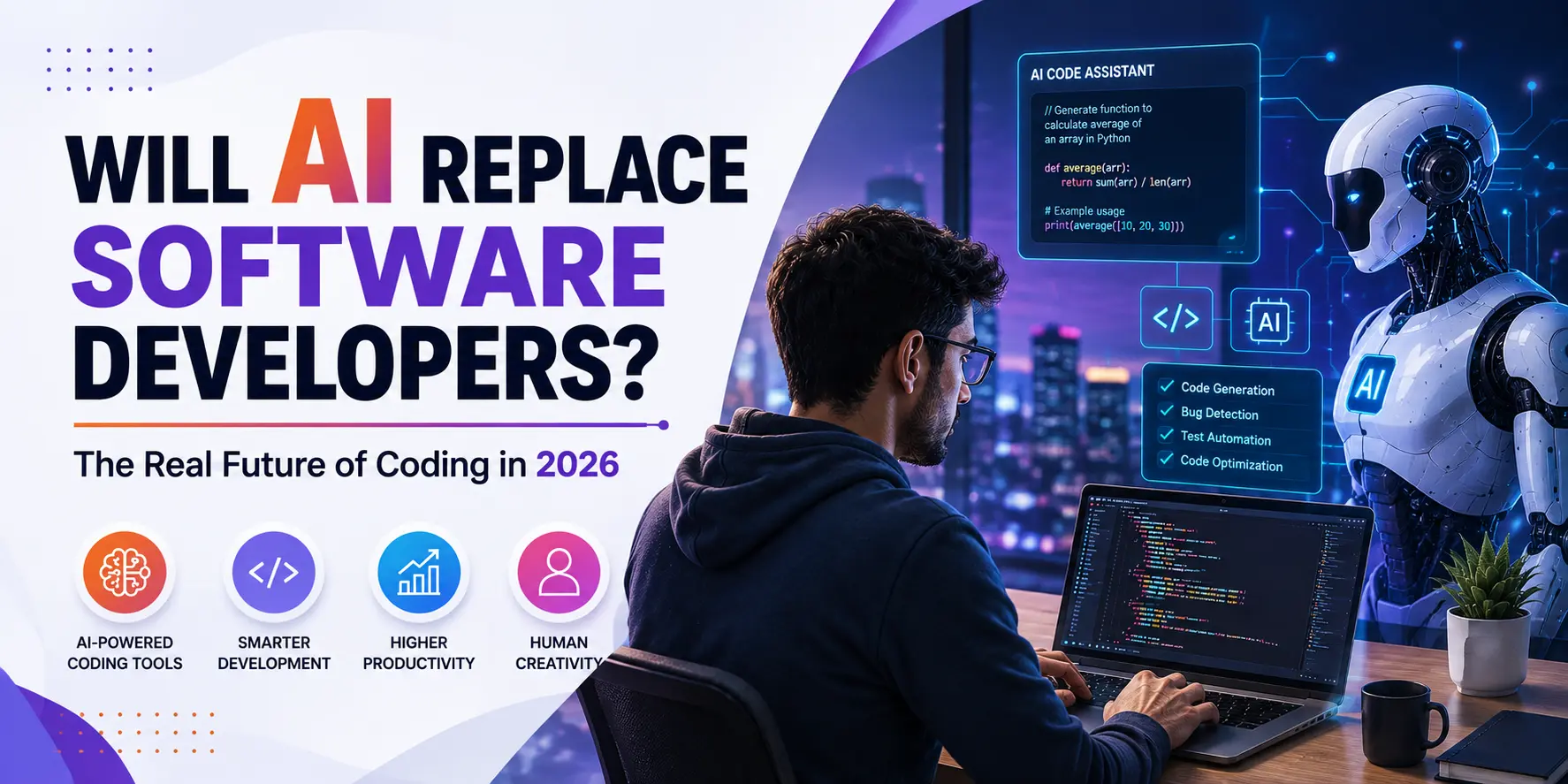
Will AI Replace Software Developers?
Over the years, developing software is regarded to be among the most secure jobs in the tech industry. Programming languages, designing applications, and understanding the architecture of software have been skills that may lead to the most lucrative technology-related jobs.
The 2026 year is a new debate.
Artificial Intelligence can now create codes, teach programming concepts and detect bugs. It can also create tests, alter the existing software and aid developers in complex tasks of development. The AI-powered programming tools are becoming an integral component of software development process, not being a new technology.
This raises a significant issue for students, developers as well as technology firms and businesses:
Does AI take over software developers?
The short answer is that AI is not likely to entirely replace developers of software however, those who are aware of how to use AI may be able to replace software developers that don't.
This distinction may become one of the biggest professional lessons from the AI time period.
AI Is Changing How Software Is Built
Traditional software development typically demands developers write manual code, learn the programming language, identify bugs and constantly test their software.
AI changes several components of the process.
Modern AI programming assistants are able to take instructions from natural languages and then generate functional codes. Developers can specify what they'd like to develop and get recommendations for components, functions databases, APIs, as well as complete applications.
Google, OpenAI, Anthropic and a host of other companies in the field invest heavily in AI technologies that are able to assist with software engineering and programming.
The Google AI ecosystem, for instance it is continuing to grow the scope of its AI capabilities across various products and developers tools. AI programming tools are rapidly being integrated into mainstream workflows for software development.
It doesn't mean that the need for programmers is diminishing.
The role of a programmer is starting to evolve.
From Writing Code to Giving Instructions
One of the major effects of the generative AI is that it has moved from writing each line of code to simply describing what software is supposed to do.
Imagine that a web developer wishes to build an account page.
Before, developers might be required to create HTML, CSS, JavaScript as well as backend codes in a manual manner.
In the present the AI computer can produce an initial version upon receiving instructions such as:
"Create an interactive page for login that incorporates email and password authentication, reset password feature, form validation and password reset."
Developers can go through the code generated, try the code, spot any issues and then improve the design.
It means that the skill has shifted beyond:
"Can you write codes? "
Then it becomes more and more:
"Can you recognize a problem and design the best solution, and then use AI efficiently to construct it? "
This is an even greater ability.
AI Coding Tools Are Getting Better
The speedy advancements of AI programming tools is a major reason why this debate is now so crucial.
Modern AI technology can handle massive codebases and can understand the connections between files, and recommend adjustments across various elements of an application.
AI is able to assist developers with jobs such as:
Writing code that is repetitive
Making web components
Making API integrations
Doing the search for bugs
Explaining unfamiliar code
Writing Unit tests
Creating documentation
Converting code between languages
Optimizing existing code
Creating database queries
Basic applications are created.
Examining pull request requests
Automating repetitive development tasks
As a result, developers can do more tasks in less time.
However, productivity isn't an exact equivalent to complete automation.
Why AI Still Cannot Completely Replace Developers
AI produces amazing code, however the process of developing software is more than just creating software.
A real software project involves decisions.
What is the actual thing that an application should accomplish?
Which technologies should be employed?
How can user information be safeguarded?
Then what happens when thousands, or millions of users utilize the app?
What is the best way to respond to a problem?
What are the best ways to have business requirements transformed into technical requirements?
The answers to these questions are dependent on the context of judgment, responsibility and.
AI could suggest solutions however, humans must assess whether the suggested solutions are truly suitable.
The code may appear perfect but still have an security flaw due to faulty business logic, or a the issue of scaling.
It is for this reason that the need for skilled developers remains important.
The Biggest Risk May Be for Junior Developers
It is ironic that AI could have a greater influence on developers at the beginning of their careers as compared to senior engineers.
The junior developers typically devote a lot of their time working on tasks that are repetitive.
These could be basic parts and fix minor bugs. They could also create documentation, or even modify tiny parts of code.
This is exactly the kind of jobs AI tools are increasingly assisting in.
Therefore, firms might require fewer workers in some of the repetitive tasks.
This may make tech job market for entry-level positions more than competitive.
There is a second aspect to the story.
AI can be a great aid for novices to master.
Student who was previously struggling in understanding a concept of programming is now able to ask the AI software to clarify the concept in plain language, offer illustrations and assist in debugging errors.
Instead of replacing the need for learning, AI can potentially become an individual programming tutor.
It is important to distinguish the use of AI to discover or makes use of AI to stay away from studying.
The New Developer: AI-Augmented Programmer
The next developer could be very different from those of the past.
Instead of spending all the time writing code, developers can spend their time doing:
The design of systems
Understanding customers
Reviewing code created by AI
Applications for testing
Controlling AI agents
Improved software architecture
Protection of applications
Technical choices
Connecting different services
Resolving complex problems
That is, AI could move developers to higher abstraction levels.
The computer takes care of the tedious application.
The human is the one who handles most than the logic.
AI Agents Could Change Coding Even More
The following major breakthrough is not just AI that can write individual functions.
It's artificial intelligence agents capable of performing multiple-step tasks for development.
A AI agent may be able to analyse an entire project, spot the issue, change multiple files, conduct tests, identify issues and alter them further.
It's quite different from just soliciting for an AI chatbot to write some code.
Agentic AI might eventually convert software development into a process in which humans decide on goals while AI systems take care of several of the steps in between.
It could drastically improve the efficiency of developers.
It also presents new problems.
It is up to the agent to determine which agent to use check its output and be accountable for the end result.
Will Programmers Become Less Important?
Not necessarily.
A definition of what a programmers is could be changed.
Take a look at what happened to calculators.
Calculators made it easier for human beings to do manual calculations. However, mathematics didn't disappear.
Similarly, graphic design software did not eliminate design.
Search engines have not completely eliminated any research.
Spreadsheets have not eliminated financial professionals.
Technology typically alters the work that people do rather than taking away a whole profession in a single day.
Software development may take the same path.
AI could help reduce the amount of code that is manually written, while also increasing the value of problem-solving as well as designing systems.
Which Developer Skills Will Become More Valuable?
As AI is able to handle more repetitive programming tasks, a few skills might increase in value.
1. Problem Solving
The understanding of the real issue is far more crucial than being able to type code swiftly.
A person who knows the business needs can direct AI to a practical solution.
2. System Architecture
Larger applications demand decisions on database databases, APIs, security, infrastructure, and scalability.
The decisions can't be handed over to AI.
3. Cybersecurity
AI-generated software can be vulnerable.
The developers who are aware of security be more valuable as one must verify whether AI-generated software is secure.
4. Communication
The developers of the future must communicate with marketing, designers as well as business groups and customers.
Ability to translate requirements from business into technological solutions is one of the major advantages.
5. AI Literacy
They do not have to be able to turn into AI researchers.
However, they must be aware of the way AI software works and where they can be useful as well as where they could fail.
6. Code Review
Coding may be easier.
The ability to determine if the generated code is of good quality could become a greater value skill.
Should Students Still Learn Programming?
Absolutely.
The way that students learn programming might have to be changed.
Students shouldn't be focusing solely on learning the syntax.
Instead, they need to be aware of:
Programming fundamentals
Data structures
Algorithms
Databases
APIs
Git and Version Control
Web development
Cybersecurity fundamentals
Software architecture
Debugging
Testing
AI-assisted development
The fundamentals of learning become crucial in the context of AI generates software.
If the student doesn't know how to program, they might not be able to recognize when AI created an error in the software.
This creates a risky dependence.
It is best to follow these steps:
Learn to program and master AI Tools.
Not:
Learn to code because AI is here.
What Happens to Coding Jobs?
Software companies are unlikely to stop hiring software developers in a flash.
However, job descriptions could develop.
The companies are likely to look more and more for software developers that can operate efficiently using AI instruments.
The developer who produces identical results in only two hours instead of hours due to their ability to apply AI efficiently can be extremely important.
It could also enable smaller teams to create items that would previously require bigger teams.
This could be very important.
A small group of engineers and AI tools could develop websites, mobile apps, SaaS products and internal automation tools much more efficiently than it was before.
The Rise of the "10x Developer" Could Take a New Form
The term "10x developer" has been used for a long time to refer to engineers who are extremely productive.
AI can enhance this idea.
Developers who are knowledgeable about business requirements, software architecture and AI tools may be able to generate significantly higher output than someone who relies entirely on hand-coding.
But, the level of productivity shouldn't be measured by only the quantity of codes written.
A lot of code doesn't translate to more software.
An experienced developer will know the right time to not to code.
The best option is to use a simplified architecture, an existing service, or an automated process.
Could One Person Build a Startup Using AI?
It is among the interesting outcomes of AI programming.
The past was when launching tech startups could have required designers as well as frontend developers, testers, backend developers, and DevOps engineers.
AI can help lower certain of these hurdles.
A founder who has the technical skills is now able to use AI tools that can help accelerate:
Website development
UI design
Backend development
The setup of a database
Creation of content
Marketing
Customer support
Analysis of data
Automation
However, this doesn't mean anyone can build the next billion-dollar corporation.
The business plan, distribution strategy customers' understanding, distribution strategy and execution remain a struggle.
The cost for experimenting on a new technology concept has been reducing.
AI Will Replace Some Tasks Before It Replaces Jobs
This could be the most accurate method of assessing the future.
Instead of requesting:
"Will AI replace developers? "
A better question is:
"Which jobs that developers perform are they able to let AI automatize? "
There are numerous repetitive tasks.
Software engineering is a complex field with several tasks that require judgment as well as creativity, a sense of context, and the ability to be accountable.
Thus, the next decade is likely to be more about change in jobs as opposed to immediate job elimination.
Certain roles could shrink.
The new roles could be announced.
Developers who are already in the field could become more efficient.
Companies may also expect engineers to do even more.
The Future of Coding Is Human + AI
The most skilled developers in the coming decade might not be those with the majority of code.
It is possible that they are able to combine:
Human creativeness and technical expertise + AI tools and critical thinking.
AI is transforming into a formidable developer partner.
A partner needs some direction.
If programmers blindly believe everything AI creates, the quality of software could be harmed.
If the developers are able to grasp the basic concepts and utilize AI smartly, this technology will be an enormous increase in productivity.
This is the reason why the process of learning AI is not a sign of abandoning programming.
This means that you need to understand the way programming evolves.
Final Verdict: Will AI Replace Software Developers?
The solution is more nuanced rather than just a simple"yes" or "no.
AI is a replacement for some code-related task.
AI is a way to help to reduce the requirement for repetitive programming.
AI will alter basic developer roles.
The challenge of completely replacing developers poses a greater task.
Software development requires understanding of individuals, companies, systems Security, risk, and longer-term implications.
AI can generate code.
Humans are still deciding which things should be constructed and if it can be taken seriously.
The most successful developers who are likely to be successful in the next few years are not those fighting AI.
They'll be the ones to learn how to utilize it.
Programming's future might thus not:
Humans vs AI.
It could mean:
Humans that use AI in comparison to humans who do not.
If you are a student interested in pursuing a career in tech The message is clear:
Never stop learning to program. Make your code more readable with AI.